Agentic Demand Generation
The Agentic Demand Engine: Reimagining B2B Demand Generation
What would demand generation look like if human capacity were no longer a constraint?
What if every meaningful buyer signal could be evaluated, every buying-group member could receive a relevant experience, every product trial could receive personalized guidance, and every seller could be equipped with actionable buyer intelligence?
What is agentic demand generation?
I envision an intelligent demand engine that brings together market intent, digital engagement, CRM intelligence, and product usage signals to continuously determine the most appropriate next action.
Specialized AI agents, working together through an orchestration layer, execute and coordinate personalized experiences across self-service, marketing-led, and sales-assisted journeys.
Humans define the strategy, bring institutional knowledge, establish guardrails, and exercise judgment.
Business outcomes and agent performance inform continuous optimization.
But building this engine doesn't start with AI.
It starts with identifying the business problems worth solving, reimagining the processes that support them, and determining how humans and AI agents can work together to deliver better outcomes.
The goal isn't more automation. It's a more intelligent, adaptive, and effective demand generation engine.
My guiding principles of agentic demand generation
- Business first, AI second
- Start with the business problem, not the technology.
- Reimagine before automating
- Don't just make existing processes faster. Challenge how the work gets done.
- Signals over schedules
- Buyer and product behavior should drive engagement, not predetermined campaign calendars alone.
- One buyer, connected journeys
- Integrate product-led, marketing-led and sales-led experiences.
- Orchestration over isolation
- Specialized agents need shared context, goals and coordination.
- Human judgment by design
- Humans bring expertise, strategy, creativity and accountability.
- Autonomy is earned
- Expand agent responsibilities as reliability and business value are demonstrated.
- Outcomes over activity
- Measure pipeline, conversion, revenue and customer experience — not simply agent activity.
How the agentic demand engine works
Connected buyer intelligence, specialized AI agents, and human expertise — organized in six layers.
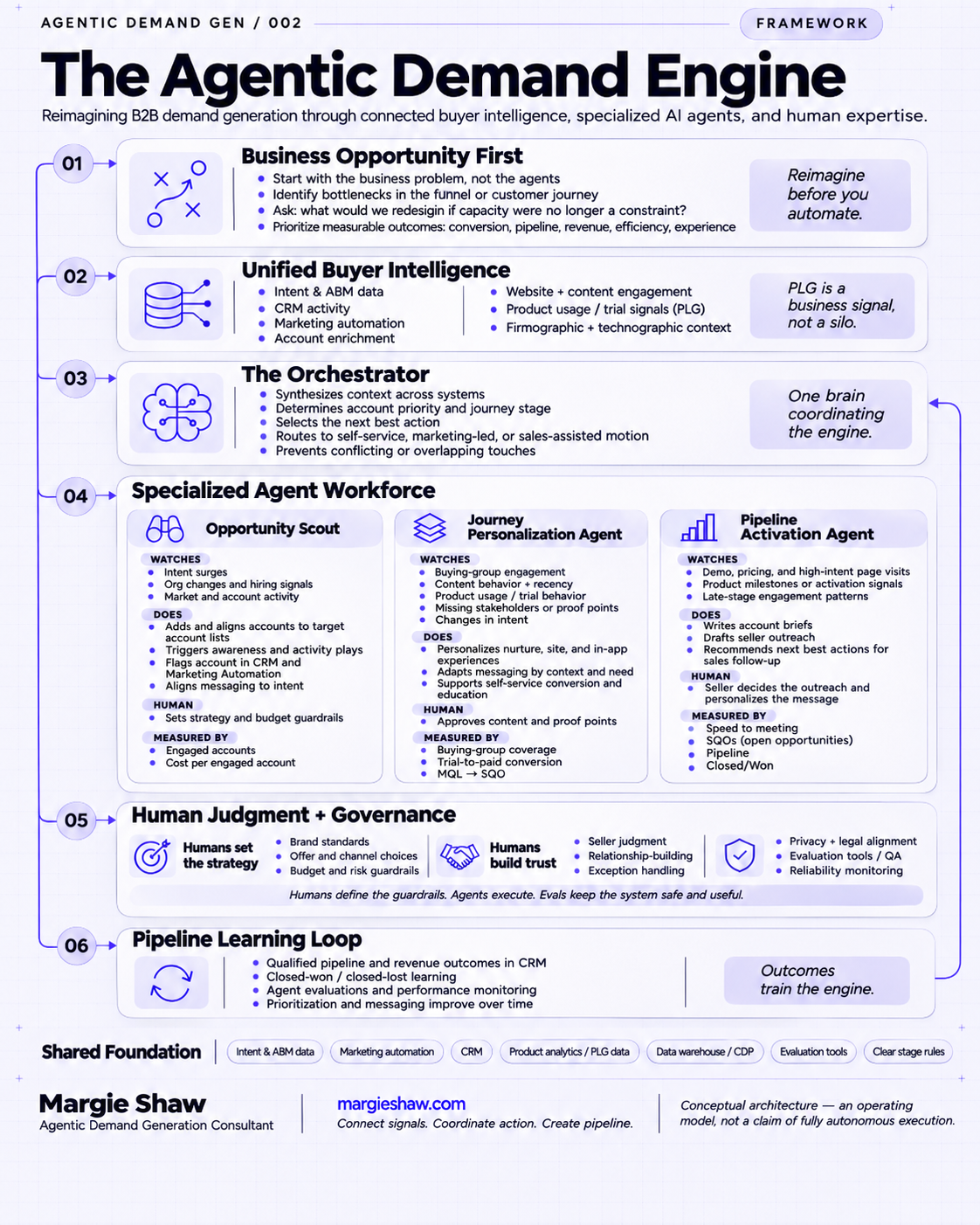
- 01
Business Opportunity First
Reimagine before you automate.
- Start with the business problem, not the agents
- Identify bottlenecks in the funnel or customer journey
- Ask: what would we redesign if capacity were no longer a constraint?
- Prioritize measurable outcomes: conversion, pipeline, revenue, efficiency, experience
- 02
Unified Buyer Intelligence
PLG is a business signal, not a silo.
- Intent & ABM data
- CRM activity
- Marketing automation
- Account enrichment
- Website + content engagement
- Product usage / trial signals (PLG)
- Firmographic + technographic context
- 03
The Orchestrator
One brain coordinating the engine.
- Synthesizes context across systems
- Determines account priority and journey stage
- Selects the next best action
- Routes to self-service, marketing-led, or sales-assisted motion
- Prevents conflicting or overlapping touches
- 04
Specialized Agent Workforce
Opportunity Scout
- Watches
- Intent surges, org changes and hiring signals, market and account activity
- Does
- Adds and aligns accounts to target lists, triggers awareness and activity plays, flags accounts in CRM and marketing automation, aligns messaging to intent
- Human role
- Sets strategy and budget guardrails
- Measured by
- Engaged accounts, cost per engaged account
Journey Personalization Agent
- Watches
- Buying-group engagement, content behavior and recency, product usage and trial behavior, missing stakeholders or proof points, changes in intent
- Does
- Personalizes nurture, site, and in-app experiences; adapts messaging by context and need; supports self-service conversion and education
- Human role
- Approves content and proof points
- Measured by
- Buying-group coverage, trial-to-paid conversion, MQL → SQO
Pipeline Activation Agent
- Watches
- Demo, pricing, and high-intent page visits; product milestones or activation signals; late-stage engagement patterns
- Does
- Writes account briefs, drafts seller outreach, recommends next best actions for sales follow-up
- Human role
- Seller decides the outreach and personalizes the message
- Measured by
- Speed to meeting, SQOs (open opportunities), pipeline, closed/won
- 05
Human Judgment + Governance
Humans define the guardrails. Agents execute. Evals keep the system safe and useful.
- Humans set the strategy: brand standards, offer and channel choices, budget and risk guardrails
- Humans build trust: seller judgment, relationship-building, exception handling
- Privacy + legal alignment, evaluation tools / QA, reliability monitoring
- 06
Pipeline Learning Loop
Outcomes train the engine.
- Qualified pipeline and revenue outcomes in CRM
- Closed-won / closed-lost learning
- Agent evaluations and performance monitoring
- Prioritization and messaging improve over time
Shared foundation
- Intent & ABM data
- Marketing automation
- CRM
- Product analytics / PLG data
- Data warehouse / CDP
- Evaluation tools
- Clear stage rules